


OTD – How professionals manage delivery dates in the manufacturing industry
Delivering on promises builds trust. In today's world, where technology is constantly speeding up, businesses and customers alike expect speed and reliability. This is not only true when we order goods online – it is also true in manufacturing. Here, On-Time Delivery (OTD) has become one of the key measures of success.
We dive into the subject with Fredrik Nilsson, MPS consultant at Monitor ERP, who has worked for over 15 years with complete ERP integrations in both small and large manufacturing industries.
Four conditions for delivering on time
- An integrated quote flow that can quickly provide realistic delivery dates.
- A planning system that builds on real-time data and creates sustainable production schedules.
- A system that can anticipate capacity shortages, material needs, and machine efficiency.
- A solution that ties all the pieces together into a whole – giving you full control over the entire production flow.
What is OTD?
In simple terms, OTD means that you deliver to the customer on the date you have agreed. More precisely, it is the percentage of deliveries that reach the customer on the promised date. Here, we start from what was actually promised to the customer – the date stated in the offer.
Getting started with data-driven and auto-generated, delivery times already in the quote is not complex, but it does require some organization.
What is the OTD of top performing companies?
Within international benchmark reports, OTD (On-Time Delivery) is consistently highlighted as one of the three most critical operational KPIs, along with productivity and quality (ASCM/SCOR). In the SCOR model (Plan, Buy, Produce, Deliver, Return), OTD is specifically defined as "delivered by a set date", where you measure by the date given to the customer.
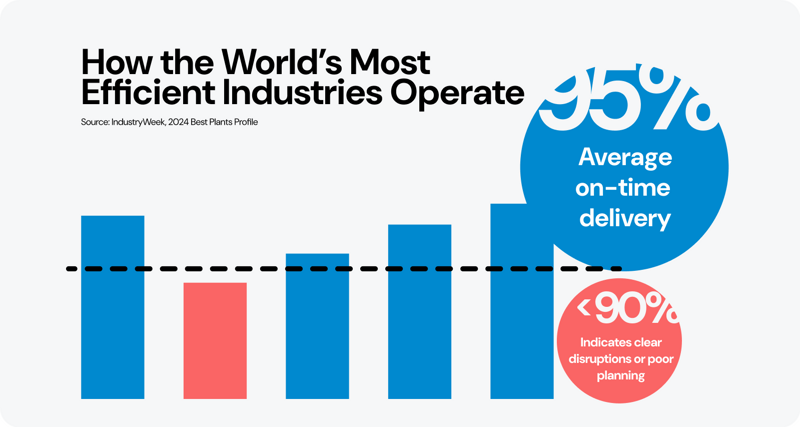
Among plants ranked as the world's most efficient – for example in IndustryWeek Best Plants – the same pattern emerges: the median OTD is in the high 95% range, with nearly 70% of these plants also measuring against an algorithmically calculated promised date (IndustryWeek, 2024 Best Plants Profile, PDF).
This makes delivery accuracy one of the pillars for measuring the supply chain, along with productivity and quality. The study also underlines that professionals count anything below 90% OTD as problematic and a clear warning signal.
But numbers aside, the biggest driver is customer satisfaction. If you succeed, you'll build long-term relationships, strengthen your brand, and open doors for future business. Fail and you risk being passed over for someone who can deliver.
Delivery time promises that are not met can do great damage to a company. In time-critical industries such as healthcare and defense, late deliveries can result in direct penalties. But hidden costs due to deteriorating customer relationships are, of course, a common risk for companies that lack a systematic approach to managing delivery dates.
Fully integrated flow – all basic data for safe delivery dates
OTD has become a critical success factor, but it is not easy to achieve. It requires the whole business to be connected:
- Supply chain
- Document management
- Production capacity
- Human resources
- Payment flows
All this creates large amounts of data. Without an integrated system to collect, analyze, and share this information, the risk of missed deadlines is high.
Silos in operations are the root problem
Maintaining clear communication between all departments is often the most difficult part. Without a common system, there is a risk of misinterpretation, missing documents, and other mistakes that will be costly in the long run.
Examining communication silos is a common first step in our implementations. A modern ERP system often becomes the catalyst – or the starting point – for better collaboration between departments.
Why you need a modern ERP system
A modern ERP system gathers all data in a common database that everyone can see. It can also be linked directly to the machines, giving you real-time data on capacity, machine downtime, and production rates. This results in fewer errors, updated orders, and invoices, and above all, a much better chance of keeping your delivery promise.
A lot of work takes place automatically in the background. Monitor ERP's Check delivery times (CDT) continuously calculates dates based on current material rows and operations, no matter how many, and also takes other customer orders into account.
More questions for Fredrik Nilsson about OTD
What is the main obstacle to implementing effective OTD monitoring?
The real challenge is not in the technology, but in how people work together around it. "We've always done it this way" becomes the mantra. To change behavior, you need to clearly show what the benefits are for the whole company. Management needs to be fully on board and show that they are serious about the change.
How to deal with unexpected disruptions such as breakdowns and sick leave?
We build in buffers from the start. Calculate 80% available capacity instead of 100% and allow for about three percent sick leave and other disruptions. It also provides greater incentive to work preventively both around the machinery and the culture.
What happens when sellers promise dates that production cannot meet?
Delays spread like ripples. Someone has to work overtime. Other customer deliveries are affected. In the worst case, the company has to pay penalties for critical deliveries, especially in healthcare or defense where a week's delay can be catastrophic.
How can ERP-supported planning reduce production bottlenecks?
An ERP system cannot magically remove your bottlenecks. But with Monitor's Delivery Time Monitoring, you can easily detect patterns around which machines or production groups are negatively affecting your company's delivery times. This provides a concrete basis for investments that can shorten your delivery times.
Why is a complete ERP system, with integrated support for purchasing, production, and warehousing, crucial?
Because you get complete integration. When everyone is working from the same data, your business can eliminate communication silos, reduce errors, and enable you to plan and deliver on time.
More about Fredrik
Fredrik Nilsson has spent 15 years as a Materials and Production Management (MPS) consultant at Monitor ERP, specializing in manufacturing, purchasing, sales, and stock systems. His experience spans the entire breadth of Swedish manufacturing, from emergency phones in elevators to cutting-edge defense systems. Most recently, Fredrik has been working as an internal consultant, supporting all Monitor consultants around the world.
For more information on implementing effective on-time delivery systems in your manufacturing business, contact Monitor ERP System.

-

White papers
How top companies reach 95% delivery accuracy
Fredrik Nilsson, with 15 years of experience in ERP integrations, explains how data-driven delivery times and real-time planning make the difference.
-

Customer cases
PLC Industries achieves on-time delivery with Monitor ERP
In the fast-paced domain of precision manufacturing, PLC Industries Pte Ltd faced mounting challenges in meeting on-time delivery (OTD) targets and optimizing their operational processes. Back in 2018, as their sales surged, the strain on their limited human resources became evident. With machines n
-

White papers
Guide to choosing an ERP system – from strategy to long-term value
Are you considering a new ERP system? Here we go over the most important points to bear in mind before choosing a new system.
-

White papers
How to take control of your sustainability data and make your company more competitive
Read our article where we go through three key questions you can ask your customers regarding sustainability data reporting.
-

White papers
What type of ERP system is right for your business
Not sure which ERP system is best for your business? Find out what the difference between a standard and a customized ERP system is and what pays off in the long run!
-

White papers
The road to a successful implementation
Fill out the form below and you can look forward to downloading your guide to a new ERP system.
-
White papers
Your guide to optimizing your production
Choose an ERP solution for your industry. Download your guide to optimizing your ERP system.
-

In-depth articles
Tired of tied-up capital in the warehouse?
Discover how to streamline warehouse management and win back control of your stock
-

Customer cases
LEAX Skaraborg boosts efficiency with Advanced stock management
When LEAX Skaraborg chose to implement Advanced stock management, their daily workflow improved significantly. From manual and time-consuming to efficient and well-structured. “I’d recommend Advanced stock management to other companies. I don’t understand how we managed without it! Advanced stock ma
-

White papers
Seven tips for minimizing production costs and increasing competitiveness
Monitor ERP is a reliable ERP system provider with 50 years of experience in the Swedish market. Here, we share seven tips to help you minimize production costs and increase your manufacturing competitiveness.
-

Customer cases
Monitor ERP the logical choice for Indexator
With production based in the Västerbotten town of Vindeln – as it was from the start – Indexator dates back to the 1950s. The firm manufactures rotators and related equipment for a worldwide clientèle. "Our customers include manufacturers of forestry machines and excavators such as John Deere, Komat
-

Customer cases
Monitor improves Darekon's supply chain management
Darekon is a contract manufacturer of medical devices and industrial electronics. Since 1985, the family-owned business has grown and expanded its operations. Today, three of its manufacturing sites operate in Finland, and one site is based in Poland. We decided to go on a grand tour to visit all t